
Back in the day, George Wallace stood firm during the Selma to Montgomery Alabama march for voting rights.
LBJ sends federal troops to Alabama to protect a civil rights march
On March 20, 1965, President Lyndon B. Johnson notifies Alabama’s Governor George Wallace that he will use federal authority to call up the Alabama National Guard in order to supervise a planned civil rights march from Selma to Montgomery.
Intimidation and discrimination had earlier prevented Selma’s Black population—over half the city—from registering and voting. On Sunday, March 7, 1965, a group of 600 demonstrators marched on the capital city of Montgomery to protest this disenfranchisement and the earlier killing of a Black man, Jimmie Lee Jackson, by a state trooper.
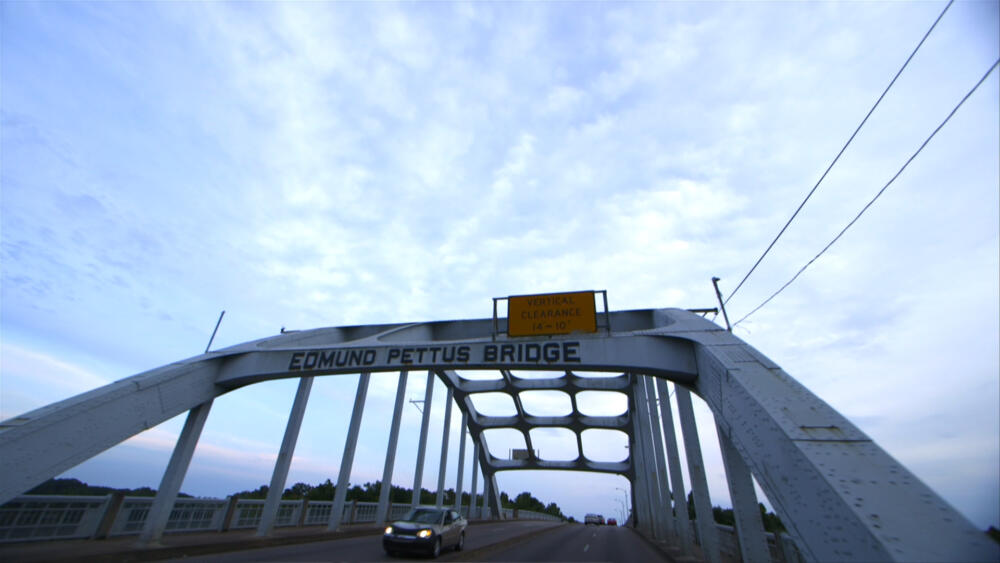
Bloody Sunday
On March 7, 1965 around 600 people crossed the Edmund Pettus Bridge in an attempt to begin the Selma to Montgomery march. State troopers violently attacked the peaceful demonstrators in an attempt to stop the march for voting rights.
4:05m watch
In brutal scenes that were later broadcast on television, state and local police attacked the marchers with billy clubs and tear gas. TV viewers far and wide were outraged by the images, and a protest march was organized just two days after “Bloody Sunday” by Martin Luther King Jr., head of the Southern Christian Leadership Conference (SCLC). King turned the marchers around, however, rather than carry out the march without federal judicial approval.
After an Alabama federal judge ruled on March 18 that a third march could go ahead, President Johnson and his advisers worked quickly to find a way to ensure the safety of King and his demonstrators on their way from Selma to Montgomery. The most powerful obstacle in their way was Governor Wallace, an outspoken segregationist who was reluctant to spend any state funds on protecting the demonstrators. Hours after promising Johnson—in telephone calls recorded by the White House—that he would call out the Alabama National Guard to maintain order, Wallace went on television and demanded that Johnson send in federal troops instead.
Furious, Johnson told Attorney General Nicholas Katzenbach to write a press release stating that because Wallace refused to use the 10,000 available guardsmen to preserve order in his state, Johnson himself was calling the guard up and giving them all necessary support. Several days later, 50,000 marchers followed King some 54 miles, under the watchful eyes of state and federal troops.
Arriving safely in Montgomery on March 25, they watched King deliver his famous “How Long, Not Long” speech from the steps of the Capitol building. The clash between Johnson and Wallace—and Johnson’s decisive action—was an important turning point in the civil rights movement. Within five months, Congress had passed the Voting Rights Act, which Johnson proudly signed into law on August 6, 1965.
How Selma’s ‘Bloody Sunday’ Became a Turning Point in the Civil Rights Movement
The assault on civil rights marchers in Selma, Alabama helped lead to the Voting Rights Act.

Related Stories

Republican Party founded

FROM WIKIPEDIA
The Ole Miss riot of 1962 (September 30 – October 1, 1962), also known as the Battle of Oxford,[2] was a race riot that occurred at the University of Mississippi—commonly called Ole Miss—in Oxford, Mississippi, as segregationist rioters sought to prevent the enrollment of African American applicant James Meredith. President John F. Kennedy eventually quelled the riot by mobilizing more than 30,000 troops, the most for a single disturbance in United States history.
In the wake of the Supreme Court‘s 1954 decision Brown v. Board of Education, Meredith tried to integrate Ole Miss by applying in 1961. When he informed the university that he was African American, his admission was delayed and obstructed, first by school officials and then by Mississippi Governor Ross Barnett. In a bid to block his enrollment, Barnett had Meredith temporarily jailed. Multiple attempts by Meredith, accompanied by federal officials, to enroll were physically blocked. Hoping to avoid violence and ensure Meredith’s enrollment, President Kennedy and Attorney General Robert F. Kennedy had a series of unproductive telephone negotiations with Barnett.
In preparation for another registration attempt, federal law enforcement were dispatched to accompany Meredith to maintain order, but a riot erupted on campus. Partly incited by white supremacist and former General Edwin Walker, the mob assaulted reporters and federal officers, burned and looted property, and hijacked vehicles. Reporters, U.S. marshals, and the U.S. Deputy Attorney General Nicholas Katzenbach sheltered in the Lyceum, the university’s administrative building into the late morning of October 1. One hundred and sixty marshals were injured, including 28 marshals who received gunshot wounds while defending the Lyceum from an attacking mob using smoke grenades, tear gas, and bayonets. Two civilians were killed during the riot, Paul Guihard, a French journalist, and Ray Gunter, a jukebox repairman. Unaware of the riot, President Kennedy made an Oval Office address, saluting Mississippi’s help in registering Meredith. Once informed, Kennedy invoked the Insurrection Act of 1807 and had U.S. Army units under Brigadier General Charles Billingslea quell the riot.